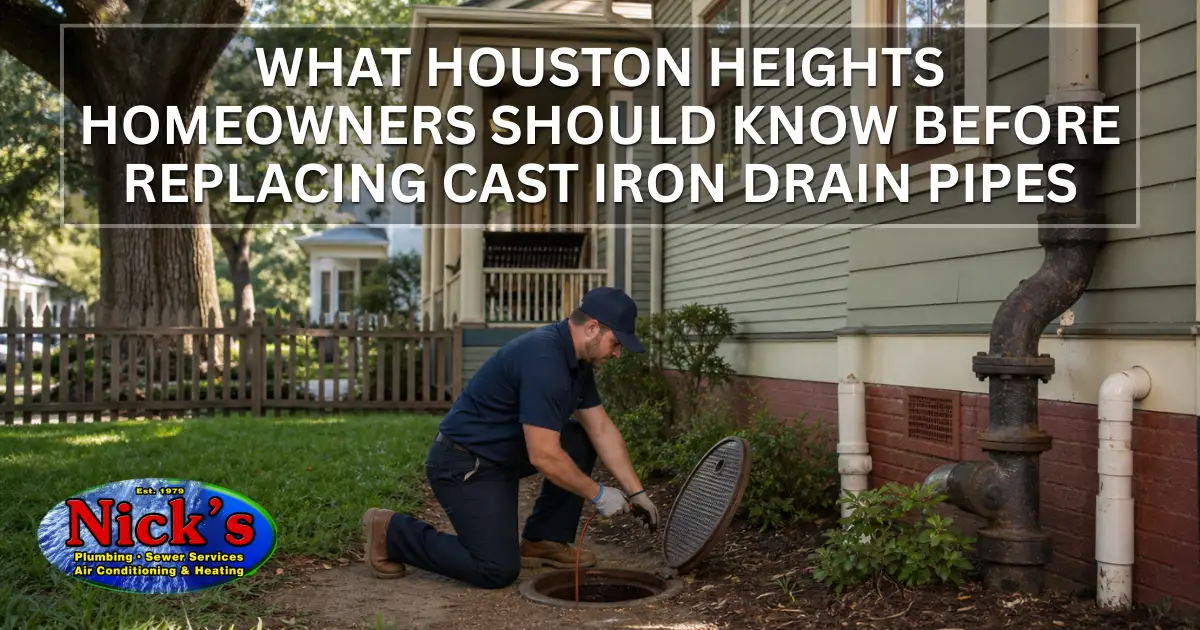
If your Heights home was built before 1975, there is a decent chance it is sitting on a cast-iron drain system that has not been touched since the day the final pipe fitting was tightened.
And at some point – maybe last week, maybe five years ago – a drain started running slow. Then another one. A plumber came out, snaked it, and it cleared up. Now, the clog has come back. And you just overheard your plumbing technician mention the words “full repipe,” followed by a number that had a comma, to repair it.
Before you authorize anything, read this.
What Cast Iron Actually Does Over Time (And Why It Is Not Always an Emergency)
Cast iron drain pipe was the standard in Houston residential construction from the 1940s through the early 1970s. It is heavy and durable, and when installed correctly, it is a genuinely good pipe material. A lot of it is still doing its job right now, in homes all over the Heights, Montrose, and Garden Oaks.
But cast iron does age. And what happens during that aging process is not a mystery.
The inside of the pipe develops a layer of rust scale over decades. That scale builds up, narrows the pipe’s diameter, and starts catching grease, soap, and debris that would have flushed right through when the pipe was new. Eventually, you get slow drains. Then recurring clogs. Then a plumber tells you the pipe is failing.

That part is usually true.
What is not always true is the jump to “you need to replace all of it right now.”
The Question Every Heights Homeowner Should Ask First
Do I really need to replace it – or can it be repaired?
This is the type of question that separates an honest plumber from one who is not as gracious. In a market where commission-driven techs get paid more when the ticket is bigger, it is a question worth asking directly.
Here is the honest answer: it depends on what the plumbing situation in question actually looks like.
Cast iron can fail in several ways. Rust scale buildup is the most common – and in many cases, hydro jetting (high-pressure water cleaning) can strip that buildup out and buy the system several more years of life. Active cracks, separated joints, or collapsed sections are a different story. Those cannot be hydro jetted back to health. That is when replacement – partial or full – is actually warranted.
The only way to know which situation you are in?
A camera inspection. A licensed plumber runs a camera through the line, looks at what is actually there, and shows you what they are seeing. Not what they are assuming. Not what “typically happens” with cast iron of a certain age.
What Is Actually in Your Pipes?
“He was so professional, he explained my issues in detail, provided me with pictures so I could see the problem for myself.” – G.W., Houston TX
That is what it should look like. If a plumber is recommending a full replacement without having run a camera, that is a conversation worth pausing until getting a second or third opinion.

What Does a Repipe Actually Involve – and When Is It the Right Call?
If the camera shows what it sometimes shows in Heights homes – multiple sections of collapsed or badly cracked pipe, joints that have separated, or scale buildup so severe that jetting cannot address it – then yes, replacement is the right answer. And it is worth doing correctly.
Full cast-iron repipe on a Heights-era home typically means replacing the drain lines under the slab or within the walls with PEX or copper pipe. It is not a small job. Depending on the scope, it can mean opening up flooring, cutting through concrete, or working inside walls. A house this old usually holds a few surprises once you get in there and start poking around.
That is not a valid excuse to avoid it. That is the reason you hire someone who has done it enough times to know what the surprises look like – and how to handle them without the job doubling in scope and price.
“Luiz and Gray showed up on time and were very considerate. They covered their shoes to prevent tracking dirt in the house. They looked at each job and explained what the problem was and how it would be fixed.” – Jenny Genna, Houston, TX
Many of the Heights-area homes we work in are not just “houses” to the people who live in them. Many of our Heights customers have lived in their homes for 20, 30, or even 40 years before passing them down to younger family members. That historic house is their legacy.
We know that. We act like it.
What This Costs – The Honest Range
Let us talk real numbers, because that is how we do things.
If the camera shows the line is heavily scaled but structurally intact, hydro jetting is usually the first option explored. Hydro jetting service starts at $750 and generally runs between $750-$1,500 depending on the length of the sewer line, the condition of the sewer line, and what is inside the sewer line.
It is definitely not cheap – but it is still only a fraction of what a whole-house repipe job costs, and when it works, it buys you real time.
If significant portions of your cast-iron plumbing need to be removed and replaced, you are looking at a whole-house repipe, which, in an original Heights-era home, starts at $4,500 and can reach $35,000 on the high end. That spread is wide, and for good reason.
A 1,200-square-foot pier-and-beam bungalow with accessible lines is a very different job from a 3,500-square-foot slab home with cast iron buried four feet down and two bathrooms at opposite ends of the house. The camera tells us which one you are dealing with. The estimate tells you the exact number before anyone touches anything.
If it is a partial repipe – one failing section, one bathroom stack, one stretch of line that has collapsed – the cost lands somewhere in between. We will tell you what we find and what it will actually take to fix it. Not a range designed to get us in the door. The number.
If sticker shock is the concern, we offer 0% financing for 18 months through Service Finance. For a job this size, that turns a significant one-time hit into something a lot more manageable.
Free estimate. No service fee to come out. And if the camera shows the pipes are holding up better than expected, we will say that too.
Before You Say Yes to Anything – A Short Checklist
If a plumber has looked at your cast iron drains and is recommending work, here is what you should have before you agree:
- Camera footage – you should be able to see what they are seeing. Ask for it.
- A clear repair vs. replace recommendation – and the reasoning behind it.
- A written estimate before any work begins. Not a range. A number.
- Warranty on the work – Nick’s standard warranty is 90 days; VIP members get a full year on all repairs.
- A plumber who has actually done a cast iron repipe in Heights-era homes – the construction details in these houses are different from those in a 2005 Katy subdivision. Experience here matters.
If any of those things are not being offered, it is okay to slow down.
We Have Been in the Heights Since 1979
That is not a tagline. It is just the truth.
We have worked in these homes long enough to know exactly what 1962 cast iron looks like, how it fails, and when it needs to come out vs. when it just needs cleaning. We have also seen enough commission-driven recommendations over the years to know how much damage a bad repipe conversation can do to a homeowner’s trust.
“They told me what could wait and what couldn’t.” – J.C., Houston TX
That is the whole philosophy.
If your drains are giving you trouble and you want someone to come out, look at what is actually there, and give you a straight answer, call us at (713) 868-9907. Free estimate. No service fee. No pressure.
And if the pipes are fine, we will tell you that too.
FAQ: Cast Iron Drain Pipes in Houston Heights Homes
Do cast iron drain pipes always need to be replaced?
No. Cast iron drain pipes can often be cleaned or repaired if the pipe is structurally intact. If there are active cracks, separated joints, collapsed sections, or severe deterioration, partial or full replacement may be warranted.
Can hydro jetting fix old cast iron drains?
Hydro jetting can remove rust scale, grease, soap, and debris from cast iron drain lines when the pipe is still structurally sound. It cannot repair cracked, separated, or collapsed pipe sections.
Why should I get a camera inspection before approving a repipe?
A sewer camera inspection shows the actual condition inside the drain line. It helps distinguish between buildup that may be cleaned and physical pipe failure that requires replacement.
How much does cast iron drain replacement cost in a Heights-era home?
Costs vary widely by access, home size, pipe depth, and scope. Hydro jetting often starts around $750, while whole-house repipe projects in older homes can start around $4,500 and reach $35,000 on complex jobs.
Should I get a second opinion before replacing cast iron drain pipes?
Yes, especially if a full replacement is recommended without camera footage or a clear explanation. You should understand what the plumber saw, why replacement is recommended, and whether a repair or cleaning option is still realistic.
Need a Straight Answer on Cast Iron Drain Pipes?
Nick’s Plumbing serves the Heights, Montrose, Memorial, and surrounding Houston neighborhoods. We will inspect the line, show you what we find, and give you the number before work begins.
Call Now: (713) 868-9907 Schedule Online
Camera Inspections • Hydro Jetting • Sewer Line Replacement